
Why Uncertainty About a Person Often Gets Interpreted as Risk






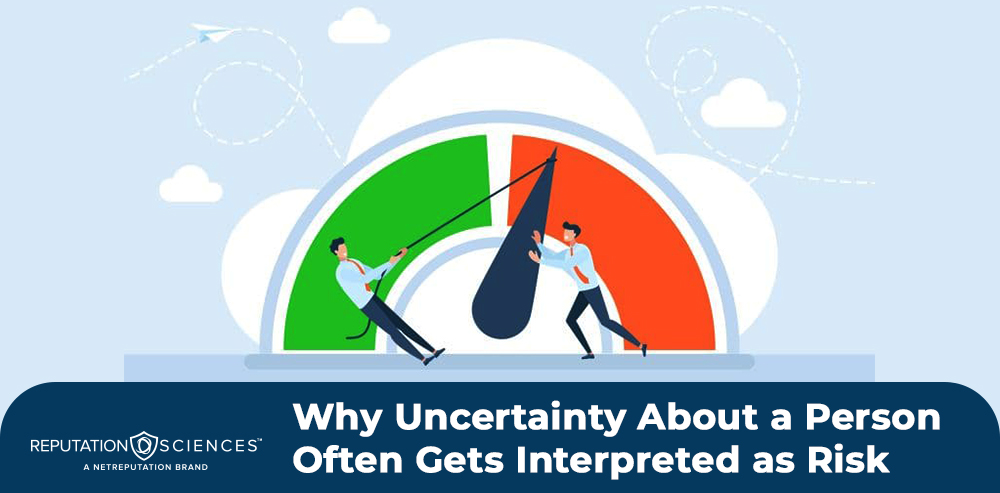
Uncertainty rarely stays neutral. When information about a person is incomplete, the gap does not sit quietly. Over time, that gap fills itself, and most often it fills with risk.
This reaction does not stem from paranoia. Instead, it reflects how human judgment operates when future outcomes remain unclear and reliable probabilities are missing. Without certainty, people often interpret ambiguity as a threat, even when no concrete threat exists.
These instincts shape hiring decisions, trust, reputation, negotiations, and leadership choices. Because of that, people with incomplete narratives often face treatment as if they pose a high risk, regardless of actual behavior or evidence.
The distinction matters because uncertainty and risk are not the same thing. Once decision-makers treat them as interchangeable, outcomes deteriorate, false precision emerges, and avoidable harm follows.
Uncertainty Is Not the Same as Risk
Risk involves known factors. By contrast, uncertainty describes what cannot be confidently estimated.
Nearly a century ago, economist Frank Knight clarified this distinction. Analysts can model risk and assign probabilities to it. Uncertainty, however, lacks any reliable probability distribution.
In practice, many decision-makers collapse that difference.
- Risk assessment assumes measurable likelihood.
- Uncertainty involves future states that resist clear analysis.
- One invites calculation, while the other requires judgment.
When people evaluate others, uncertainty arises constantly. Backgrounds remain incomplete, intentions stay invisible, and context often feels fragmented. Rather than acknowledge that ambiguity, the mind treats uncertainty as if it were quantifiable risk.
That shortcut may feel safer. In reality, it creates new problems.
Why the Brain Converts Uncertainty Into Risk
From a cognitive standpoint, uncertainty creates discomfort. Because the brain prefers prediction, it substitutes threat when prediction fails.
This response does not reflect sophisticated risk analysis. Instead, it operates as a defensive mechanism.
- In the absence of clear data, people assume negative outcomes.
- When information goes missing, perceived risk rises.
- As certainty drops, confidence in judgment weakens.
Put simply, when probability cannot be estimated, the mind inflates likelihood.
As a result, uncertainty about a person’s motives, history, or reliability often triggers harsher evaluations than known negative information. Known risks feel manageable. Unknown ones do not.
Risk Management Logic Bleeds Into Social Judgment
Formal risk management addresses uncertainty through scenario analysis, adaptive strategies, and stress testing. Human judgment rarely has access to those tools.
Because of that gap, people apply business-style risk logic poorly to personal evaluation.
The reasoning sounds familiar:
- “There are too many unknowns.”
- “The risk feels high.”
- “We cannot model future outcomes.”
- “There is too much uncertainty based on limited data.”
These statements resemble professional risk analysis. Without statistical models or reliable probabilities, however, they amount to guesswork disguised as caution.
That is how uncertainty, once framed as risk, gains authority without evidence.
The Problem of False Precision
As pressure to decide increases, people often invent certainty.
This tendency produces false precision, leading to confidence where none exists.
Common examples include:
- Overweighting a single data point
- Treating assumptions as facts
- Converting possibility into likelihood
- Confusing confidence with accuracy
In finance or engineering, Monte Carlo simulations expose this problem by revealing wide outcome ranges. Human judgment lacks an equivalent safeguard. Instead, intuition steps in and presents itself as analysis.
The result is misplaced confidence and distorted risk tolerance.
Why People Feel Riskier Than Systems
Ironically, people often face harsher judgment than systems with worse track records.
Organizations tolerate known flaws in processes, markets, and technologies because those risks feel familiar. People, however, carry reputational uncertainty, which makes future behavior feel less predictable.
Because of this imbalance:
- Systems with many risks get accepted.
- People with unclear intentions get flagged.
- Known failures feel safer than unknown potential.
The same level of risk does not feel the same when uncertainty involves human behavior.
Decision Making Under Uncertainty Favors Caution Over Accuracy
Most decision-makers prefer to be wrong safely rather than right boldly. Consequently, exclusion becomes the default response:
- Do not hire.
- Do not trust.
- Do not advance.
- Do not engage.
From a risk management perspective, this feels rational. From an outcomes perspective, it often is not.
Avoiding uncertainty does not remove risk. Instead, it trades one set of consequences for another:
- Missed opportunities
- Stalled progress
- Reputational harm
- Weaker long-term outcomes
Good risk assessment acknowledges trade-offs. Poor assessment hides them.
Known Risks Feel Safer Than Unknown Ones
Known risks can be managed, while unknown risks feel uncontrollable.
For that reason, black swan events dominate fear despite their rarity. Their probability remains low, yet their uncertainty stays high.
When uncertainty surrounds a person, the mind treats that person like a black swan event. Evidence does not drive this response. Unreliable probability does.
That pattern leads people to:
- Overestimate negative outcomes
- Ignore neutral or positive futures
- Assume worst-case scenarios
- Discount adaptive strategies
None of this improves decision quality.
Risk Professionals Do Not Treat Uncertainty This Way
Trained risk professionals resist this impulse.
They draw clear distinctions between:
- Quantifiable risk and uncertainty
- Estimated probabilities and unknown likelihood
- Expected values and possible outcomes
- Analysis and assumption
They accept that some futures cannot be modeled. Instead of inflating risk, they design flexible management strategies.
Social judgment rarely applies that discipline.
A Better Way to Evaluate Uncertainty
Uncertainty should not be punished. It should be handled deliberately.
That approach requires:
- Naming uncertainty instead of disguising it as risk
- Separating missing data from negative data
- Avoiding premature conclusions
- Acknowledging confidence limits
When uncertainty involves people, the objective should be understanding, not the elimination of ambiguity.
The goal is informed judgment, not certainty.
The Cost of Getting This Wrong
Treating uncertainty as risk feels protective at first. Over time, it becomes corrosive.
The consequences include:
- Poor decision-making
- Narrowed opportunity
- Systemic bias
- Reputational damage
- False confidence in flawed outcomes
Risk management exists to support better decisions, not fear-driven ones. When uncertainty gets misclassified as danger, both logic and fairness suffer.
The Real Risk
The real risk is not uncertainty itself.
Instead, the danger lies in pretending uncertainty has right answers when it does not, then acting as though caution equals correctness.
Understanding the difference between risk and uncertainty is practical, not academic. It determines who gets trusted, who gets excluded, and which futures remain possible.
In most cases, the damage comes not from uncertainty, but from how quickly it gets mistaken for a threat.
